

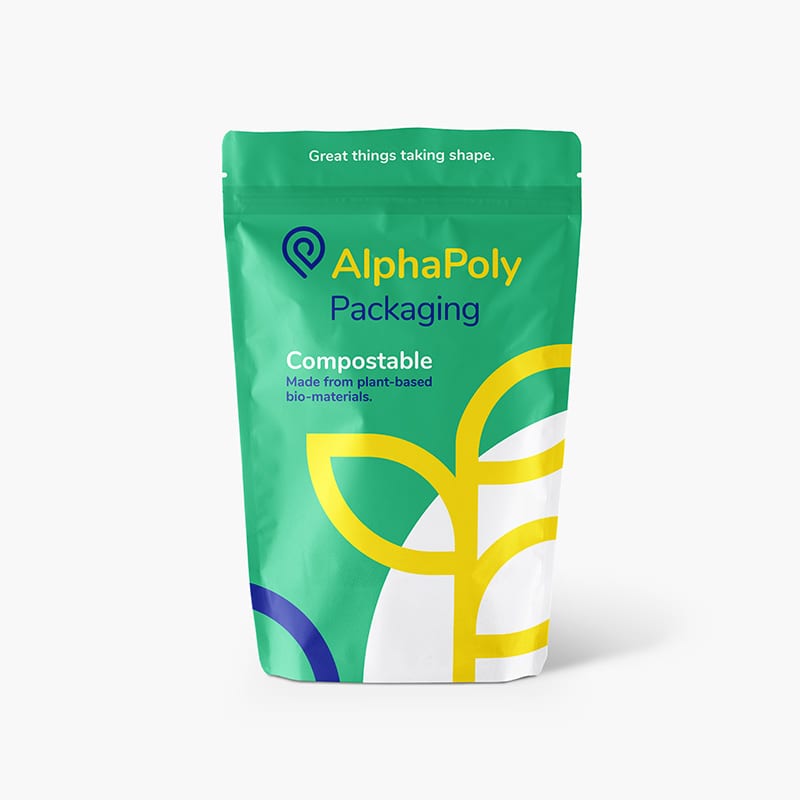
Compostable Packaging
Compostable pouches mean your brand’s legacy won’t be the trash it left behind. Your compostable packaging can be made to any specification. The FDA certified compostable packaging AlphaPoly offers is made from plant-based bio-materials designed to breakdown into non-toxic soil when processed by commercial composting facilities.
Specs
- BPI certified compostable laminates, films, and closures
- Meets FDA requirements for food contact
- Reduces overall carbon footprint
- Made from bio-films are based on renewable resources wood-pulp (birch trees), compostable PE
- Freezer safe
- Superior strength
FAQs
Here’s some commonly asked questions about compostable packaging.
Compostable packaging is made from organic materials that can break down naturally and return to the soil without leaving behind any toxic residue. The process of composting works by utilizing microorganisms, moisture, and oxygen to decompose the packaging into compost, which can then be used as nutrient-rich soil for plants.
Compostable packaging typically takes around 3 to 6 months to break down in a composting environment. However, the exact time can vary depending on factors such as temperature, moisture levels, and the specific composition of the packaging material. Additional, there is a difference in composting speed if using commercial composting facilities.
Compostable packaging is generally more expensive than traditional packaging materials, primarily due to the higher production costs, however, as economies of scale are achieved, the cost difference can decrease.
While compostable materials offer an eco-friendly packaging option, there are limitations to their use. Not all products are suitable for compostable packaging due to factors like durability, moisture resistance, and shelf life requirements. Compostable materials often lack the strength and barrier properties provided by traditional plastics, making them less ideal for products that need strong protection or long-term preservation. It’s best to contact an Alphapoly sales rep for your specific needs.
Compostable packaging from sugar cane and corn starch shares several sustainability benefits with wood-pulp (from birch trees) and compostable polyethylene (PE) packaging. All these materials reduce the environmental impact compared to traditional plastics by contributing less to landfill accumulation and associated methane emissions. Both sugar cane and corn starch, as well as wood-pulp packaging, are derived from renewable resources and are biodegradable, meaning they break down more efficiently than conventional plastics. In terms of energy use, sugar cane and corn starch may have a slight edge over wood-pulp packaging, as the latter requires more energy-intensive processes like logging and chemical treatment. However, both types use less energy compared to the production of traditional plastic packaging. As for compostable PE, while its production is energy-intensive, it offers improved biodegradability over standard PE. In terms of greenhouse gas emissions, all these alternatives emit less carbon dioxide during decomposition than traditional plastics. Overall, while there are differences in the specifics of their production and biodegradability, sugar cane, corn starch, wood-pulp, and compostable PE packaging each contribute positively to sustainability goals by offering more eco-friendly alternatives to conventional plastic packaging.
Give our sales team a call. We can speak to you about all our flexible packaging solutions. If you have questions about shipping, compostable plastic, and the pros and cons of recyclable vs. compostable solutions, we’re here to help.